kmlink

DR KLAUS MUELLER

Education

Klaus Mueller: FILMOGRAPHY AND DOCUMENTARY PROJECTS, 1988-Present

Dr. Klaus Mueller is an independent filmmaker whose work explores the long-term repercussions of the Holocaust on LGBT history. Throughout his career, he has examined how personal testimony shapes historical understanding and collective memory, focusing on individuals whose experiences have often been marginalized or excluded from public narratives. A central thread in Mueller’s work is the recording and interpretation of personal testimony. Across museums, film projects, and international initiatives, he has consistently worked with individual life narratives as a means of understanding historical violence and its aftermath. Rooted in oral history practice, this approach has informed his work across Holocaust documentation, LGBT history, and contemporary human rights contexts. Alongside his filmmaking, he has taught and written about film history.

Selected Film and Documentary Projects

• Mueller was initiator, research director, and associate producer of the award-winning documentary PARAGRAPH 175 (2000) which profiles gay survivors of Nazi persecution. Mueller has worked with gay survivors since the early 1990s.

• He was assistant director and assistant producer of the Dutch documentary BUT I WAS A GIRL (1999) which is based on his extensive 1994 oral history interview with lesbian Dutch resistance fighter Frieda Belinfante in Santa Fe, New Mexico. See 2021 USHMM Pride Month: Defying Nazi Persecution on Frieda Belinfante.

• In 1998, Mueller co-produced and directed JUST HAPPY THE WAY I AM on LGBT Youth and their experience of homophobia and fascism.

• In 2017 Mueller directed FAMILY IS…? A GLOBAL CONVERSATION, which explores the complexities of LGBT lives within their families of birth, their families of choice and the families they raise.

• In 2018, he was interviewed by Iranian director Maziar Bahari in the documentary 82 NAMES: SYRIA, PLEASE DON’T FORGET US. See also interview film.

• As a historian and adviser, Mueller worked with Eurovision Song Contest winner Duncan Laurence in 2022 on a documentary about the LGBT+ COMMUNITY DURING WWII.

• In 2022, he was interviewed about his work as an oral historian for a series of video lectures on INTERVIEWING GAY SURVIVORS, produced by “Hear Our Voices”, a project of Carleton University, Canada.

• Between 2022-2024, Mueller served as the historical and dramaturgical consultant on the 2023 NETFLIX Documentary ELDORADO: EVERYTHING THE NAZIS HATE. The documentary tells the story of the world’s first highly visible queer community and its destruction under National Socialism.

• In 2023, Mueller was interviewed by Austrian filmmaker Fritz Kalteis for the bio-documentary PERSECUTED LOVE – THE MEN WITH THE PINK TRIANGLE on gay survivor Heinz Heger (Josef Kohout). Mueller helped to preserve Kohout’s original pink triangle and a larger collection of family correspondence relating to Kohout’s incarceration in Flossenbuerg concentration camp through his cooperation with Kohout’s long-term partner. The collection is now accessible at the United States Holocaust Memorial Museum. See also comment on the significance of Heinz Heger’s memoir.

• In 2023, Mueller collaborated with Iranian director Maziar Bahari on six short films, BERLIN: CITY OF MEMORIALS, in which he explores the history, architecture, and contemporary relevance of Berlin’s memorials on location.

• Based on his early and extensive research on Gottfried von Cramm, including work in the Library of Congress, Mueller was interviewed in 2023 by German director Annette Baumeister for the documentary  PLAYING TO SURVIVE: VON CRAMM VS HITLER (2024), which explores the life of one of the twentieth century’s great tennis champions and his relationship with Jewish actor Manasse Herbst in Nazi Germany. See Trailer (2024).

Teaching and Writing about Film

• Mueller taught film and cultural history at the University of Amsterdam (1993-2002), conducted public film programs on gay survivors at the United States Holocaust Memorial Museum (1993-1999), and developed and led film seminars at the Friedrich-Ebert Foundation and Goethe-Institute Amsterdam (1990-1993). He has written film and cultural criticism for the Frankfurter Allgemeine Zeitung, Frankfurter Rundschau, Homologie, and De Groene Amsterdammer, and has published academic articles and lectures on film and cultural history since 1988.

Education

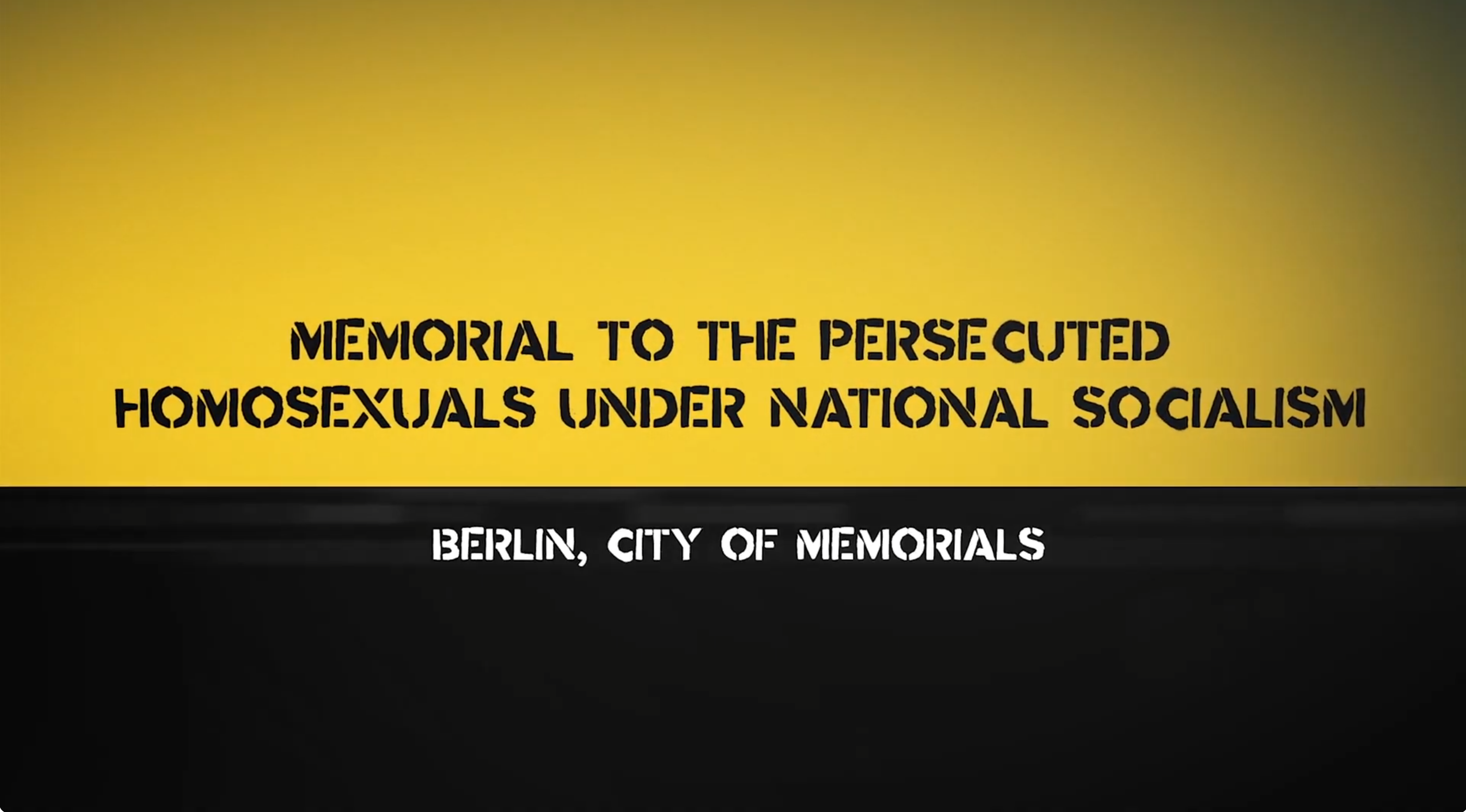
Film about Memorial to Homosexuals Persecuted under Nazism (IranWire/USHMM 2023)

Link: Memorial to Homosexuals Persecuted Under Nazism

IranWire’s Maziar Bahari visited Berlin to meet with Mueller to make a series of short films as part of the Sardari Project. One of these films explored the Memorial to Homosexuals Persecuted Under Nazism and Mueller’s personal history connected to the memorial. Bahari and Mueller spent several days visiting six different memorial sites across Berlin to discuss how these memorials came into being and the significance they hold today and potentially for the future. All films became part of the Berlin: City of Memorials documentary series. These films are published on IranWire and associated social media sites in English and Persian.

Berlin is a city of memorials. But this has not always been the case. The post-war years were characterized by heated national debates about how Germany should remember the horror of its past. And these debates continue to this day. Successive German governments have been either reluctant to create memorials or uncertain about how best to do so – but individuals have led the way. Dr Klaus Mueller, the Representative for Europe at the US Holocaust Memorial Museum (USHMM) is keen to emphasise that most memorials have come about as the result of the efforts of a small number of people, who determinedly made the case for its need.

In Germany, the creation of a new memorial has the power to spark a nationwide discussion. These are personal and political questions. How has the country dealt with its responsibility for the murder of European Jews? Has it reckoned with the Nazis’ persecution of suppressed minority groups such as Roma and Sinti, homosexuals, Jehovah’s Witnesses or people with mental and physical disabilities? Post-reunification, what message did the German government want to send to the world about its attitude towards the country’s past? What do memorials mean for victims?

FILMS:

Education

INTERVIEW in film 82 NAMES: SYRIA, PLEASE DON’T FORGET US (USHMM 2018/2021)


82 Names: Syria, Please Don’t Forget Us is a documentary film that traces the journey of Mansour Omari, a survivor of torture and imprisonment in Syria. Omari, a Syrian human rights activist who was imprisoned for nine months and tortured by the Assad regime, smuggled out scraps of cloth recording the names of all 82 of his cellmates. The United States Holocaust Memorial Museum* is exhibiting them to raise awareness of atrocities committed by the regime. This is Mansour’s story.
In chapter 7, during a visit to Germany, Mansour learns about the history of Holocaust memory in that country, where Nazi rule precipitated the murder of six million Jews and and other victims from 1933–1945. All of Germany’s memorials began with the efforts of individuals or small groups and encountered resistance, says Klaus Mueller, the United States Holocaust Memorial Museum’s representative there. The first step, Mueller said, is remembering the victims—a process Mansour has started in Syria by saving some of their names.
See USHMM website 82 Names: Syria, Please Don’t Forget Us
See Film talk at 2021 Munich DOK.fest about 82 Names with Maziar Bahari, Joumana Seif, Dr. Klaus Müller, Emanuel Rotstein
See Discussion on 82 Names at Munich Forum for Islam.

*Views expressed on my website are my own and do not necessarily represent those of the United States Holocaust Memorial Museum.

Education

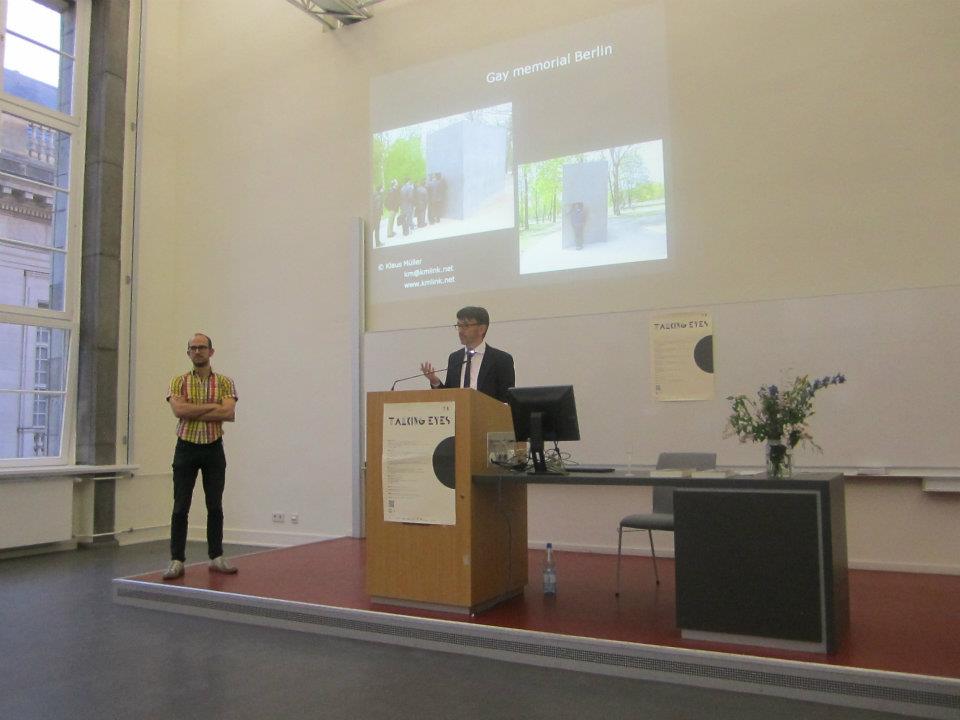
LECTURE – TURNING GAY VICTIMS INTO PERPETRATORS

Humboldt University, June 14, 2012

Dr. Klaus Mueller: In the blink of an eye: Post-war constructions of (in)visibility of victims and perpetrators, Jun 14, 2012 at Humboldt University Berlin, Chair: Todd Sekuler – PLEASE ACCESS THE TALKING EYES WEBSITE FOR MORE

This presentation explores the opposition between the post-war invisibility of gay survivors of the Nazi regime and the desire of post-war society to portray Nazis as homosexuals. In order to forget that ‘ordinary’ men and women had become perpetrators, the Nazi was portrayed as an outsider: deviant and degenerate. Homosexuality came to signify transgression into evil. Due to their exclusion from post-war memory, some gay survivors blamed themselves for their victimization. Their shame, ongoing persecution, and – above all – post-war silence constitute a disturbing figure: the speechless victim. Using various films, including the film within the Berlin Memorial to Homosexuals persecuted under Nazism, the discussion thus moves between the invisible victim and the post-war image of a perpetrator, both of which served collective and voyeuristic needs.

Education

REDE ALS JURYMITGLIED ZUR ÜBERGABE DES NEUEN FILMS IM BERLINER HOMOMONUMENT (Berlin, Jan 2012)

Please find photos and speech also here:

Sehr geehrte Damen und Herren, liebe Freundinnen und Freunde,

Danke für die Einladung! Berlin hat viele Denkmäler, aber nur eines davon integriert eine Filmsequenz: Das auf dem Entwurf von Michael Elmgreen und Ingar Dragset basierende und 2008 eingeweihte Denkmal für die im Nationalsozialismus verfolgten Homosexuellen. In unmittelbarer Nähe zum Denkmal für die ermordeten Juden Europas zitiert es dessen architektonische Sprache der Stelen.

Wenn man abends dort läuft, zwischen Brandenburger Tor und Potsdamer Platz, überrascht das Licht der im Denkmal projizierten Filmbilder. Was gibt es dort zu sehen? Man muss sich an ein schmales Glasfenster stellen, das in die Außenwand des Denkmals eingelassen ist: jeweils nur eine Besucherin kann nach innen schauen. Gezeigt wird eine Endlosschleife von zwei sich küssenden jungen Männern.

Der Kuss als visuelles Thema soll an die NS-Zeit erinnern, in der ein Kuss zwischen zwei Männern als strafbar gewertet werden und vielleicht zu Verhaftung, Gefängnis, oder gar einer Einweisung in ein KZ führen konnte. Ein Einführungstext vor dem Denkmal erklärt diesen Zusammenhang.

Der Film selbst vermeidet historische Assoziationen: wir sehen einen Kuss im Hier und Jetzt von Berlin. Wann haben Sie zum letzten Mal den Kuss zwischen einem Mann und einer Frau bewusst als solchen wahrgenommen? Sich dazu in Bezug gesetzt? Über Öffentlichkeit nachgedacht?

Die filmische Inszenierung konfrontiert mit der unbequemen Einsicht, dass das Bild zwei sich küssender Männer zu Beginn des 21. Jahrhunderts eine Erfahrung bestimmter Art konstruiert. Wieso ist das so? Was sehen wir da? In diesem Kuss? Das Denkmal wurde seit 2008 dreimal beschädigt.

Während die historische Referenz des Kusses – als ikonographischer shortcut –  nachzuvollziehen ist, öffnet sich die Denkmalarchitektur einer problematischen Ambivalenz des Schauens: Sie führt den Besucher in eine voyeuristische Betrachterposition. Die Küssenden werden zum Objekt. Nun ist dies eine reale Erfahrung für Homosexuelle, dass Zuneigung, ausgedrückt in der Öffentlichkeit, in einem Gespräch, einer Umarmung oder eben einem Kuss, zu diesem Blick von außen führt.

Die architektonisch geleitete Wahrnehmung durch das Fenster repliziert die prinzipielle politische wie visuelle Wahrnehmung homosexuellen Lebens im 20. Jahrhundert. Sie zeigt Homosexualität in eben jener  Figur, in der sie eingeschlossen war – dem Gestus des Zurschaugestelltseins. Diese Grenzziehung führte letztlich zu Diskriminierung und Verfolgung.

Die Filmsequenz löste eine öffentliche Diskussion aus, in dem der mannmännliche Kuss als Ausschluss weiblicher Homosexualität angegriffen wurde. Die Bundesregierung hat dem Denkmal eine Doppelfunktion gegeben, das in seiner Reichweite überaus fordernd ist: als Denkmal die NS-Verfolgung männlicher Homosexualität zu erinnern und gleichzeitig ein beständiges Zeichen zu setzen gegen die fortwährende Diskriminierung homosexueller Männer und Frauen heute.

Im Juni 2007 entschied die Bundesregierung, mit Zustimmung der Künstler, eine Fortentwicklung der Denkmalkonzeption durch einen jeweils zweijährigen Film Wettbewerb. Welch ungewöhnliche und wunderbare Chance: Das Denkmal verhärtet sich nicht als zu Stein gewordene Erinnerung. Stein ist hier sozusagen nur eine Hülle für Bilder, die wir projizieren wollen. Gedenkzeichen an homosexuelle Verfolgung stießen lange auf starken gesellschaftlichen Widerstand. Der Wettbewerb ermöglicht eine notwendige Diskussion: Für wen, warum, mit welchem Ziel, in welcher Form versuchen wir, an die historische Verfolgung zu erinnern und ein Zeichen gegen Diskriminierung heute zu setzen?  Ist die NS-Verfolgung ein extremer Ausdruck von Homophobie oder eine singuläre Ausnahme in einer Geschichte relativer Intoleranz? Was erschließt, was verschließt sich durch den Vergleich des Schicksals der Männer mit dem rosa Winkel mit dem lesbischer Frauen im Nationalsozialismus?

Die durch die historische Forschung dokumentierte Differenz findet breiten Konsens bei Lesben und Schwulen. Doch zu Recht wird auf die Strafbarkeit weiblicher Homosexualität in Österreich und auf Einzelfälle verfolgter lesbischer Frauen verwiesen und die Frage gestellt, wie die prekäre Lebenssituation lesbischer Frauen im dritten Reich – nach der Zerschlagung der lesbischen Kultur der zwanziger Jahre – in unserer Gedenkkultur angemessen thematisiert werden kann. Lesbische Frauen, die ins Visier der Kriminalpolizei gerieten, erfuhren die Verachtung seitens der staatlichen Behörden und ein gesellschaftliches Klima der Rechtlosigkeit; nur die Geringschätzung lesbischer Sexualität veranlasste das NS-Regime, diese nicht unter Strafe zu stellen. Die Diskussion, die sich an dem Erstlingsfilm entzündete – emotional, kontrovers, und konzentriert nach Antworten suchend – bedeutete einen wichtigen Zugewinn, in dem sie diese Fragen ernst nahm.

Wird die historische Erinnerungsfunktion des Denkmals durch den stark hervorgehobenen Gegenwartsbezug potentiell geschwächt?

Die Zeit, und der öffentliche Umgang mit dem Denkmal, unser Umgang wird das zeigen. Für die Überlebenden der Homosexuellenverfolgung kam die Anerkennung zu spät. Sie lebten und starben allein mit ihren Erinnerungen. Welchen Film wir auch wählen – ihnen sind wir Gedenken schuldig, in immer wieder neu zu findenden Ausdrucksformen. Das Denkmal kann hier nur einen Beitrag leisten.

Unser Gedenken kann sich weder von der Vergangenheit verabschieden, noch sich in ihr einschließen. “A memorial unresponsive to the future would violate the memory of the past.”: Ein Denkmal, das auf die Zukunft nicht reagiert, verletzt die Erinnerung an die Vergangenheit, so fasst Elie Wiesel den Zusammenhang von Gedenken und Verantwortung zusammen. Mit dem Untergang des NS-Staates sind dessen totalitären homophoben Auffassungen nicht verschwunden. In Europa haben Homosexuelle zunehmend ähnliche Rechte wie Heterosexuelle. Doch in vielen Staaten werden sie von Grundrechten ausgeschlossen und verfolgt. Religionen werden als Plattform für Intoleranz, gar Hass missbraucht.

„Aus seiner Geschichte heraus hat Deutschland eine besondere Verantwortung, Menschenrechtsverletzungen gegenüber Schwulen und Lesben entschieden entgegenzutreten“, so die Gedenktafel vor dem Denkmal. Die Selbstverpflichtung der Bundesregierung ist eine entschiedene Aussage. Wir können ihr nur nachkommen, wenn wir  – über Landesgrenzen hinweg – die menschenverachtende Propaganda gegen Homosexualität benennen und bekämpfen: ob in Uganda, Malawi, Iran, Russland oder dem Vatikan. Hier entscheidet sich, ob Gedenken selbstbezüglich bleibt oder aus ihm Verantwortung erwächst.

Der gewinnende Film des Wettbewerbs 2011 ist eine Produktion von Gerald Backhaus, Bernd Fischer und Ibrahim Gülnar, und ich gratuliere schon einmal ganz herzlich.

Der Film spielt ganz erkennbar im Berlin von heute und zeigt, der Vorgabe entsprechend, Küsse von Männer- und Frauenpaaren; Vignetten des Alltags, dokumentarisch inszeniert, erkennbar. Für seine zentrale Aussage jedoch ist dies sekundär. Die Endlosschleife schlägt dem Besucher einen anderen Blick vor: den Blick auf sich selbst. Der Film bricht die voyeuristische Festschreibung der Zuschauerin: Die Kamera zoomt immer wieder aus und zeigt stattdessen den konstitutiven Blick der Mehrheitsgesellschaft auf den homosexuellen Kuss – den Blick eines Kindes, eines Nachbarn, einer Passantin, in einer Bar, im Stadium. Es sind ganz unterschiedliche Blicke.

Während man als Besucher diesen projizierten Kuss, diese intime selbstvergessene Geste wahrnimmt, sieht man sich nunmehr auch immer selbst als Beobachtenden – in diesem Blick von außen, in diesem Eingriff in die Intimität eines Paares. Der Film öffnet uns die Augen vor allem für unseren eigenen Blick auf das vermeintlich Andere.[1]

[1]Zu einer ausführlichen Auseinandersetzung mit filmischen Visualisierungen der NS-Homosexuellen-Verfolgung siehe: Klaus Müller, Zwischen Denunziation und Erinnerung. Filmische Visualisierungen der NS-Homosexuellenverfolgung, in: Claudia Bruns mit Asal Dardan/Anette Dietrich (Hrsg.), „Welchen der Steine du hebst.“ Filmische Erinnerung an den Holocaust, Berlin 2011. Eine bibliographische Übersicht zur Forschung über die NS-Verfolgung männlicher und weiblicher Homosexualität im Nationalsozialismus, auf die ich mich hier beziehe, findet sich in meinem Aussatz: Klaus Müller, Gedenken und Verachtung: Zum gesellschaftlichen Umgang mit der nationalsozialistischen Homosexuellenverfolgung, in: Insa Eschebach (Hg.), Homophobie, Devianz und weibliche Homosexualität im Nationalsozialismus. Geschichte und Gedenken. Schriftenreihe der Stiftung Brandenburgische Gedenkstätten, Berlin 2011.

BIBLIOGRAPHICAL REFERENCE SPEECH

Please also see film about Memorial to the persecuted homosexuals under National Socialism, 2024

Rede Dr. Klaus Mueller, Neuer Film im Denkmal für die im Nationalsozialismus verfolgten Homosexuellen, Übergabe an die Öffentlichkeit, Denkmal für die ermordeten Juden Europas, Donnerstag, 26. Januar 2012
Education

TEACHING FILM: NATIONAL IDENTITY, MEMORY, FILM

Teaching film history, University of Amsterdam, 1997-2002

Between 1997-2002, I taught film history at the International School for Humanities and Social Sciences,  University of Amsterdam (UvA), Netherlands. Between 1992-1996, I conducted courses on the history of sexuality within the University’s PEECH Program on European History and Culture. Member of Huizinga-Institute (1993-2002).

These interdisciplinary seminars brought together historical science, film history, and cultural studies. We approached films as products of their time: as historical sources and complex sign systems that change in the course of time and through their changing audiences. Our interest was a double focus: to learn to position a film within its historical, political and esthetic context as well as to understand our own contemporary way of looking. The seminar was organized with the support of the Goethe-Institute Amsterdam, which provided us with 16mm copies of the films.

FILM, NATIONAL IDENTITY AND THE CONSTRUCTION OF MEMORY

Post-war Germany, struggling with its Nazi past, has gone through a complex process of historical memory-work. These seminars explored the important, if not decisive position post-war German film production played in the construction of collective memories. Cinematic representations of the past and present not only influence our memory, but tend to become memories of ‘how it has been’. We investigated the relations between experience, memory and image by analyzing German films and their narrative strategies, and explored how German films dealt with guilt, denial, alienation and radical renewal.

Education

CONDUCTING FILM PROGRAMS AT GOETHE-INSTITUTE

Amsterdam, Netherlands, 1997-2001

Between 1997-2001, I conducted public film series in English or German on questions of memory and contemporary relevance, in cooperation with the Goethe-Institute Amsterdam:

  • The murderers are among us: Holocaust in post-war German film, 1997
  • Different than others: German gay/lesbian film history, 1998
  • Looking at Germany: Films by Rossellini, Resnais, Godard, Armando 2001
Education

SHOWING PUBLIC FILM PROGRAMS ON GAY SURVIVORS

United States Holocaust Memorial Museum 1993-1999

Between 1993-1999 I developed and moderated several film programs at the United States Holocaust Memorial Museum*, Washington DC, that focused on gay survivors of the Nazi regime. Some programs were shown at other locations as well.

Introduction of We were marked with a big A (Germany 1991);  Discussion with Congressman Barney Frank, USHMM, Dec 12, 1993

FILM SERIES: HOMOSEXUALS IN THE NAZI ERA, at: USHMM, May 15-19, 1994. Introduction of:
–  We were marked with a big A (Germany 1991), May 15
–  After the war you have to tell everyone – The life of Willem Arondeus (Netherlands 1990), May 15, Discussion with Congressman Gerry Studds on his recognition of Willem Arondeus in Congressional Records of 103rd Congress (1993-1994)
–  Enchanted: The Third Reich and the Economic Miracle (Germany 1993), May 17
–  The Assassin (Germany 1992), May 19; Discussion with Congressman Barney Frank
Parts of this program was also shown at West End Theatre, Oct 1994 (in cooperation with Goethe Institute, Reel Affirmations)

LECTURE AND FILM PRESENTATION, Cleveland Interfaith Congregation Chevrei Tikva, 1994

STORIES UNTOLD: LESBIAN AND GAYS DURING THE HOLOCAUST, Lecture and film presentation, Lesbian and Gay Congressional Staff Association, Rayburn House Building, Washington, Sep 1994

LECTURE AND INTRODUCTION: We were marked with a big A (Germany 1991). Imperial War Museum, Oct 1996, London

LECTURE and AMERICAN PREMIERE of BUT I WAS A GIRL, USHMM 1999

* All opinions expressed on this site are those of Klaus Mueller and do not represent the opinions of the United States Holocaust Memorial Council or United States Holocaust Memorial Museum.

Education

TEACHING FILM: FASSBINDER; DEFA; HEIMAT; AIDS

Friedrich-Ebert Foundation, Bad Münstereifel,1990-1993

Between 1990-1993, I developed and moderated one-week film seminars with guest speakers for the Kurt-Schumacher-Akademie of the Friedrich-Ebert-Foundation, Germany. The Kurt-Schumacher-Akademie in Bad Münstereifel was specialized on adult political education programs. Seminar themes included:
DEFA: The history of the East-German Film Factory
West-German films: Portraits of Immigrants, People of Color, Jews
Film and Aids: The living end
German ‘Heimat Filme’, 1933-1993
German Films in the 1970’s